
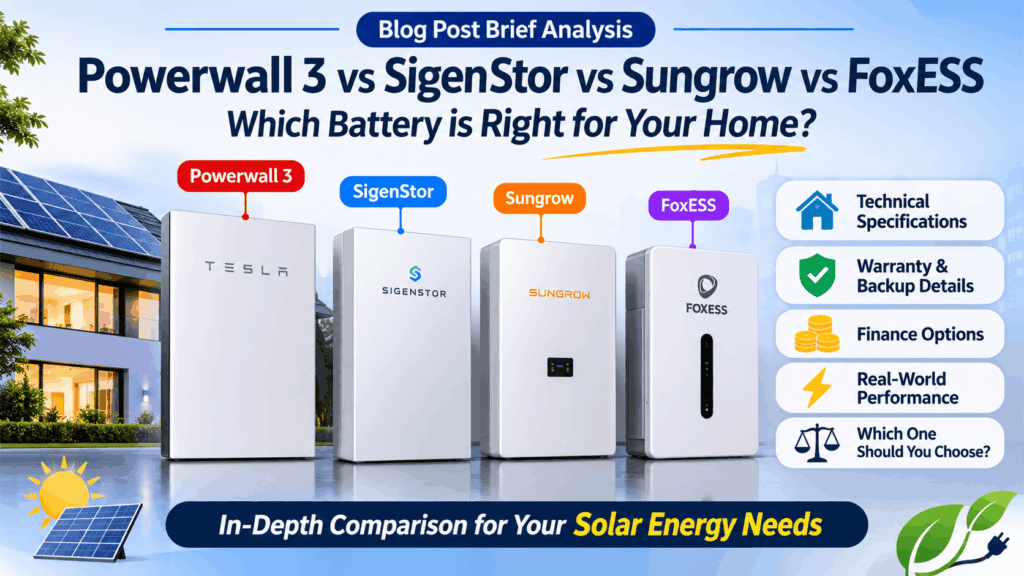
Powerwall 3, SigenStor, Sungrow and FoxESS all suit NSW homes, but they excel in slightly different ways. Powerwall 3 focuses on a simple all-in-one package. SigenStor leans into modular “stack and grow” flexibility. Sungrow and FoxESS often appeal on value and broad inverter options. The right choice depends on your home, your solar and your budget.
How This Guide Helps NSW Homeowners
This guide walks you through a practical comparison of these four brands for real-world Sydney and NSW conditions. You will see how they differ on:
- Key features such as usable capacity, power output and backup performance when the grid goes down
- Compatibility with existing solar systems and typical single or three phase grid connections
- Finance options including how the NSW Home Energy Saver Loan and the federal battery rebate can apply
- EV charging how your battery choice can support home EV chargers for day and night charging
The aim is simple. Help you narrow your shortlist with clear, honest information so you can have a confident conversation with an installer, get accurate quotes and choose a setup that fits your household, not someone else’s sales target.
Powerwall 3 vs SigenStor vs Sungrow vs FoxESS: Key Specs for NSW Homes
When you strip away the marketing, these systems all do the same core job, store solar and support your home. The differences show up in usable capacity, output, backup behaviour, warranty terms and how they fit with your existing solar and NSW grid requirements.
Usable Capacity and Power Output
Powerwall 3: Fixed all-in-one unit with a set usable capacity and high continuous output, well suited to homes that want strong backup for larger loads without much tinkering.
SigenStor: Modular stack design. You can start with a smaller usable capacity then add more units later, helpful if you plan to grow your system as your budget or EV needs change.
Sungrow and FoxESS: Typically offer a range of battery sizes. Usable capacity and output depend on the chosen inverter and battery combo, which can be tailored to small, medium or larger homes.
Backup, Warranty and Compatibility in NSW
- Backup: All four brands can support backup. Some require a specific backup box or backup inverter, and there are limits on what circuits you can realistically run during an outage.
- Warranty: Each brand has its own [insert warranty length] and [insert cycle] framework. Check both the time limit and the throughput or cycle allowance.
- Compatibility: Powerwall 3 is an all-in-one AC-coupled approach. SigenStor, Sungrow and FoxESS can be DC or AC coupled depending on models. For NSW, the system must match your single or three phase supply, your switchboard capacity and your existing solar inverter brand and size.
The key step is a proper compatibility and grid check before you commit.
Finance and Incentive Options for Home Batteries in NSW
The main public support for batteries in NSW currently comes from two directions, the NSW Home Energy Saver Loan and a separate federal battery rebate program. They work very differently. One is finance, the other is a rebate. You should treat them as separate decisions and always confirm current rules before you apply.
NSW Home Energy Saver Loan: This is a government backed loan product for approved energy upgrades such as solar and batteries. It can help spread the upfront cost over time. Eligibility usually depends on factors such as your residence, the type of upgrade and lender assessment. Interest, fees and loan terms can change, so you must check the latest conditions and product disclosure before signing anything.
Federal battery rebate program: This is a separate incentive that reduces the effective cost of a battery by providing a rebate amount. Eligibility can depend on your location, system type, installer accreditation and whether the battery is new or an addition to existing solar. Current program rules, rebate values and timing should always be checked against official government sources before you rely on them.
How homeowners use these together: Many households use a loan to cover the upfront cost, then factor any eligible rebate into their budget as a later offset. The safe approach is to get written quotes that separate hardware, installation and any expected incentive, then confirm with both the lender and official program information before you proceed.
EV Home Charger Installation Insights for Sydney and Newcastle
EV charger installs in NSW can be straightforward, provided your switchboard, wiring and chosen battery system all work together. Costs vary a lot, so it helps to understand what drives the quote and how Powerwall 3, SigenStor, Sungrow and FoxESS fit into the picture.
What Affects EV Charger Installation Cost
- Electrical capacity: Your main supply, switchboard size and existing loads. Some homes need an upgrade or new sub-board.
- Cable run: Distance and difficulty between switchboard and parking spot, including walls, ceilings and trenching.
- Charger type: Single phase or three phase, and whether you want load management or smart controls.
- Compliance and permits: DNSP requirements, metering changes and safety devices that meet NSW standards.
Expect a range of costs rather than one fixed price. Your installer should give a written quote that separates hardware and labour with a clear [insert price range] placeholder for your internal review.
How Your Battery Choice Fits With EV Charging
- Powerwall 3: Strong output and integrated control can support EV charging, especially when paired with suitable load management.
- SigenStor: Modular capacity is handy if you plan higher overnight EV charging in the future.
- Sungrow and FoxESS: Flexible inverter and battery options can match single or three phase EV chargers, provided the design matches your grid supply.
A good design looks at your EV, charger size, battery capacity and grid limits together so you can charge reliably without nuisance trips or surprises on your bill.
FAQs and Next Steps for NSW Homeowners
Do these batteries work with my existing solar?
It depends on your inverter type, system size, phase supply and switchboard. Powerwall 3, SigenStor, Sungrow and FoxESS can all pair with existing solar when the design matches your hardware and local grid rules.
Can I add a battery and EV charger at the same time?
Yes, as long as your main supply and switchboard can support the combined load. A proper design will size the charger, battery output and any backup circuits together.
How do I apply for the NSW Home Energy Saver Loan?
You start by checking if your planned battery or solar upgrade fits the current program rules, then apply through the approved lender process. Always review fees, interest and conditions before you commit.
Can I use both a loan and a federal rebate?
Often you can use a loan for upfront costs and claim any eligible rebate later, but program rules can change. Treat each program separately and confirm details with official sources.
What should I do next?
- Check your finance options. Visit /hesl-battery-loan/ to review whether the NSW Home Energy Saver Loan could suit your project.
- Confirm technical compatibility. Use the battery compatibility or contact page from the sitemap to request a detailed assessment for Powerwall 3, SigenStor, Sungrow or FoxESS at your address.
- Ask for a tailored quote. A site specific design will line up your solar, battery, EV charger and budget for NSW conditions.

