
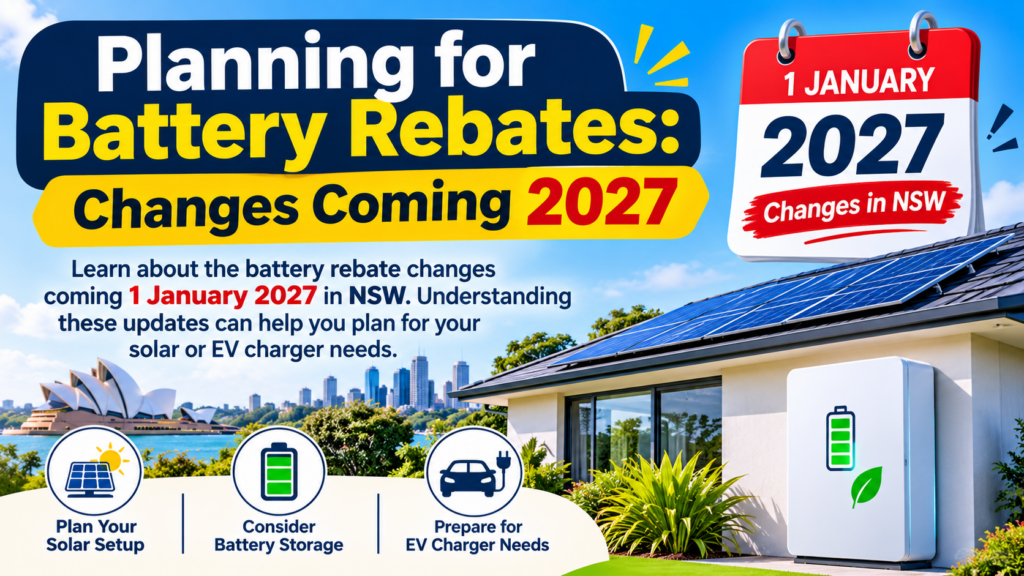
From 1 January 2027, the rules for getting a battery rebate in NSW will be different. If you are weighing up solar and a battery, adding a battery to existing solar, or planning a home EV charger, it pays to understand the changes before you lock anything in.
Introduction: What the 2027 battery rebate changes mean for you
From the start of 2027, new rebate terms will apply to home batteries in Australia. These changes affect how much support you may receive, who is eligible, and when your system needs to be installed to qualify.
For NSW homeowners and EV owners, the key points are:
- Different rules from 2027. The way rebates are calculated and approved is expected to shift to a new structure.
- Eligibility may tighten. Income limits, property type, system size, or installer requirements could change, so current assumptions might not hold.
- Timing matters. The date you sign a contract, install the system, or submit paperwork may decide which rebate rules apply.
- Battery and EV plans are linked. Your choice of battery size, brand, and wiring setup can affect how well a future or existing EV charger fits into your home energy plan.
If you are planning a system before or after 1 January 2027, you need clear, up to date advice on which rules will apply, and what that means for your budget.
Understanding the 2027 battery rebate changes
The 2027 battery rebate rules are expected to adjust how support is calculated, who can claim it, and how your installation must be set up. Treat anything you hear now as provisional, and plan to confirm details against official sources before you sign a contract.
Key rebate terms to watch in 2026.
- Rebate structure. Support may shift between a set amount per system, a rate per kWh of battery capacity, or a tiered approach based on system size.
- System criteria. There may be minimum or maximum battery sizes, approved product lists, or extra conditions for backup or VPP-ready systems.
- Installer requirements. You may need a specific accreditation level, retailer approval, or documented network approval to qualify
Eligibility points for NSW homeowners.
- Owner occupiers and investors may be treated differently.
- Existing solar owners could face different rules compared with new solar plus battery installs.
- EV owners may see extra options if the battery supports managed charging or smart controls.
Timing considerations. The rule set that applies is often linked to dates for quote acceptance, grid approval, installation, and rebate application. Before you proceed, ask your installer to confirm which scheme version will apply to your project and what that means for your out-of-pocket cost.
Battery brands and what to compare for NSW homes
When you compare home batteries for a NSW property, focus less on brand hype and more on clear, practical specs. The right choice depends on your roof space, existing solar, tariff and how you use power across the day and night.
Key technical points to check.
- Usable capacity. Look for the usable kWh, not just the headline size. This guides how much evening and overnight load you can realistically cover.
- Output power. Check continuous and peak output in kW. This affects how many appliances you can run at once from the battery.
- Backup capability. Some models can provide backup with extra hardware, others need specific backup boxes, and some do not offer backup at all.
- Warranty terms. Compare warranty length, throughput or cycle limits, and what is required to keep the warranty valid.
- Solar compatibility. Confirm if the battery is AC coupled, DC coupled, or hybrid, and whether it is approved to work with your existing inverter and monitoring.
A clear comparison worksheet helps. List each shortlisted battery with columns for [usable capacity], [continuous output], [backup type], [warranty conditions] and [compatibility notes]. This keeps brand comparisons fair, avoids guesses, and makes it easier to discuss options with your installer.
Financial assistance options in NSW
If you are planning a battery in NSW, you will usually look at two very different types of support, the NSW Home Energy Saver Loan and the federal battery rebate. One is finance, the other is a direct incentive. They can interact, but they are not the same thing.
NSW Home Energy Saver Loan
What it is: A government supported loan product offered through selected lenders for eligible home energy upgrades, which can include batteries.
- Eligibility. Often limited to owner occupiers, with conditions around property location, credit assessment, and approved products or installers.
- Lender terms. Interest rate structure, fees, loan term and maximum amount vary by lender. Always review the lender’s credit criteria and product disclosure.
- Process. You typically obtain quotes, check they meet program rules, then apply through a participating lender for pre approval before signing contracts.
Federal battery rebate
What it is: A separate program that provides a rebate or discount on eligible battery systems under national rules.
- Eligibility. Often based on system type, location, installer accreditation and ownership. Income or property limits may apply.
- Application. In many cases the installer applies on your behalf, but you remain responsible for meeting the conditions.
Always verify current details. Before committing to a loan or assuming a rebate, check the latest official program documents, lender information, and your quote, so you understand your real out of pocket cost.
Home EV charger installation insights for Sydney and Newcastle
Home EV chargers in NSW vary widely in price. The final figure depends on your switchboard, cable run, charger type and any smart features you choose. A short, simple install costs less, complex wiring or upgrades cost more. The best way to budget is to get a site specific quote.
Main factors that affect your charger cost.
- Distance from switchboard. Longer cable runs, double storey routes, and tight roof spaces add labour and materials.
- Switchboard capacity. Older boards may need safety upgrades, extra circuits or load management.
- Single phase or three phase. This affects charger size options and how much power you can deliver to the car.
- Charger features. Wi fi connectivity, load control and solar aware charging usually add to the hardware price.
- Site specifics. Wall type, weather protection, distance to parking spot, and trenching all influence the quote.
What the installation process usually looks like.
- Quick phone or online discussion about your EV, switchboard and parking layout.
- Photo or on site assessment and a fixed quote based on your property.
- Network approval if required, then installation and testing by a licensed electrician.
- App setup and handover so you know how to use and schedule charging.
Not every charger suits every home. Before you buy hardware, request a compatibility assessment that checks your EV model, existing solar or battery, and wiring. This avoids expensive changes later and helps you choose a charger that fits your broader home energy plan.

